Decentralized Wireless: The Future of Connectivity
Exploring how DeWi projects within DePin are challenging traditional telecom and empowering communities

Decentralized Wireless (DeWi) promises to disrupt traditional telecommunications by creating more equitable, accessible, and community-driven wireless networks globally. With over 70% of smartphone internet data carried via Wi-Fi networks, traditional cellular deployments have struggled to meet growing consumer demand. DeWi projects within DePin ecosystem is paving the way for decentralized alternatives.
This article provides an overview of the Decentralized Wireless (DeWi) within Decentralized Physical Infrastructure Networks (DePIN) landscape, focusing on key projects within the Solana ecosystem, highlighting how they are revolutionizing internet access and wireless connectivity by incentivizing individuals to deploy and maintain network infrastructure.
An Analysis of Decentralized Wireless Network Projects (DeWi) Within DePIN.
INDEX
Introduction to DePIN
Understanding DeWi by Approach
Key Players in the DeWi Space (Solana Ecosystem)
Helium
LongFi
WiFi Dabba
Roam
XNET
Andrena
Decentralized Wireless (DeWi) Projects: Real-World Applications.
A Comparative Analysis of Decentralized Wireless Network Projects.
Community-Powered Connections for Tomorrow.
References
Introduction
DePIN, or "Decentralized Physical Infrastructure Network," is an emerging buzz space currently in the blockchain ecosystem, it works by putting infrastructure ownership in the hands of its members instead of having big companies or governments control things like wireless networks, energy grids, or computing resources. In turn, it rewards members with tokens for participation in the projects. Messari estimates that the total TAM of DePIN exceeds $2.2 trillion, expected to reach $3.5 trillion by 2028 (1)

Within this exciting space, we have Decentralized Wireless/ WiFi (DeWi) which brings internet access to many people by letting regular folks build and run wireless networks together, instead of relying on big telecom companies (2), with 70+% of all smartphone internet data (18) and 52% of overall internet data (19) (20)being carried over Wi-Fi networks, it is clear that cellular deployments in the licensed spectrum have not been able to keep pace with consumer demands for wireless data. A notable platform for many DeWi projects is the Solana blockchain, chosen for its high throughput and low transaction costs.
One such DeWi project company within DePin space is Helium, data from Dune suggests as follows:
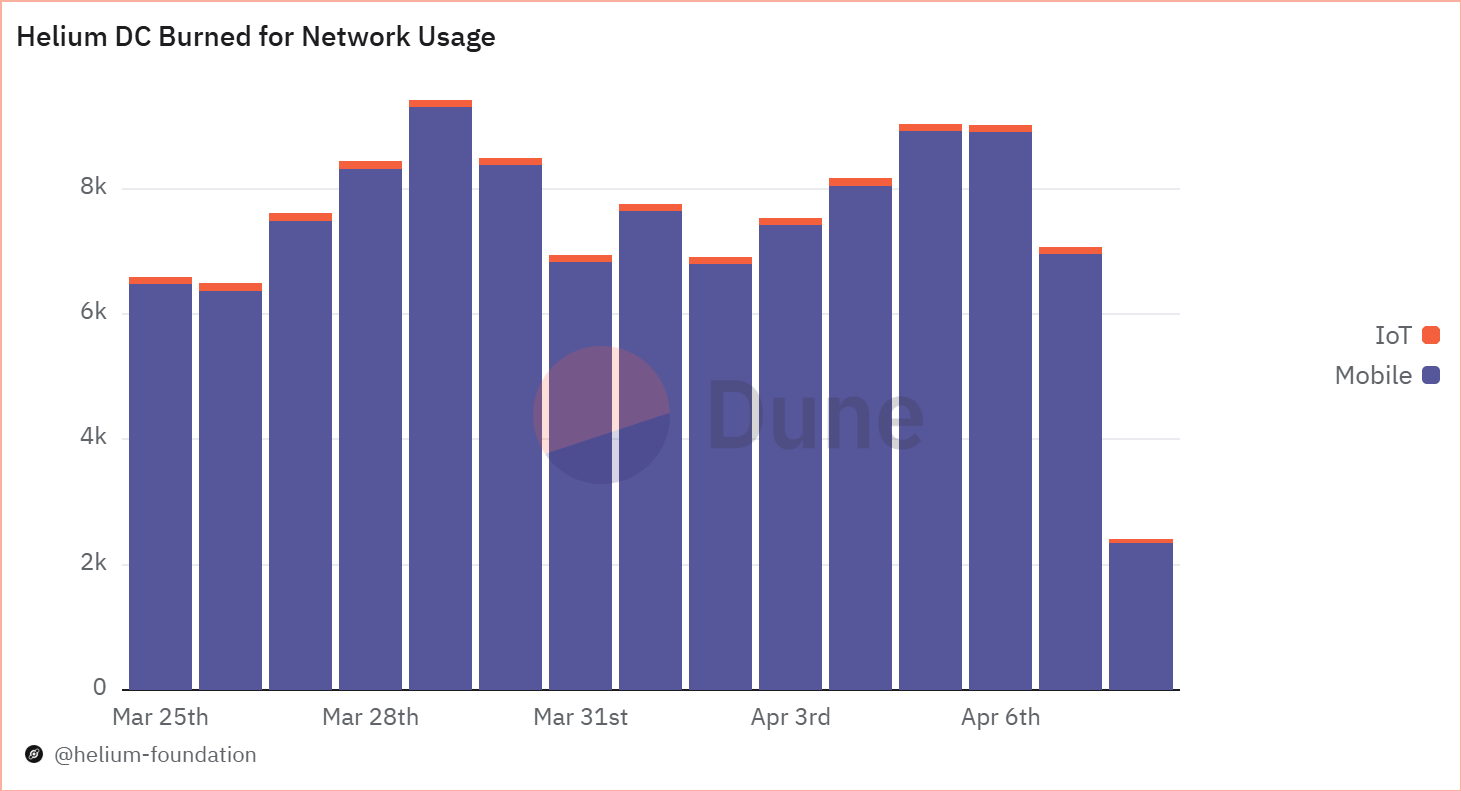
Helium DC(Data Credits) burned for Network usage between Mar 25th 2025 - April 6th 2025 (3) The chart is categorized into IoT (orange) & Mobile (blue) usage, showing a consistent dominance of Mobile usage with a noticeable drop in overall usage on April 6th.
This article delves into the key players within the DeWi landscape on Solana, their unique approaches, market positioning, and the trends shaping this sector.
At its core, DeWi seeks to decentralize the ownership and operation of wireless networks. This is achieved by incentivizing individuals to deploy and maintain network infrastructure, such as hotspots and routers, in exchange for its tokens, by leveraging blockchain technology. This approach can lower the barrier to entry for building wireless infrastructure and expand coverage to underserved areas.
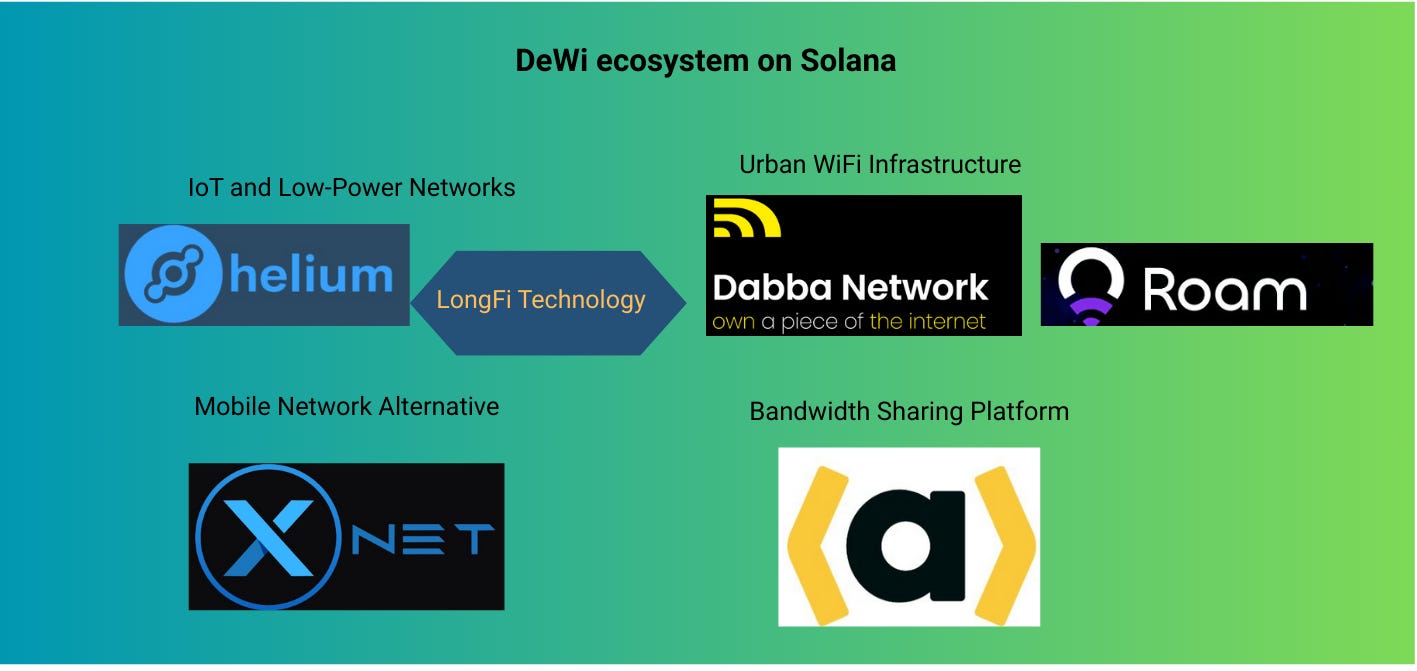
Market Taxonomy: Understanding DeWi By Approach.
1. IoT and Low-Power Networks
Focused on providing long-range, low-power connectivity
Ideal for smart city, smart agricultural, and industrial applications
Examples: Helium, LongFi
2. Urban WiFi Infrastructure
Targeting consumer and commercial WiFi access
Emphasizing local and regional network expansion
Examples: WiFi Dabba, Roam
3. Mobile Network Alternative
Offering decentralized mobile connectivity
Challenging traditional telecom models
Example: XNET
4. Bandwidth Sharing
Enables users to share their existing internet bandwidth for rewards
In a Decentralized setup with Hardware installations
Example: Andrena.
The Key Players of DeWi Space In Solana Ecosystem.
1.Helium: The Decentralized IoT and 5G Pioneer
The Helium Network was launched in 2019 with the mission of delivering a decentralized, open-source, accessible, and secure wireless network for the entire world; it has grown to be the largest LoRaWAN network globally, initially focused on providing decentralised wireless connectivity for Internet of Things (IoT) devices. Using LoRaWAN technology, Helium provides low-power networks, establishing itself as a leader in this space.
Recently, Helium has been expanding into 5G networks, deploying over 8,000 5G radios in less than a year to offer mobile connectivity solutions.The network operates by incentivizing users to deploy hotspots with rewards in HNT (Helium Network Tokens) and IOT tokens.
Helium has recently been upgraded to Solana Blockchain where now each hotspot is minted as a NFT—a process that would be financially unfeasible on any other blockchain; this accomplishment is one of the largest blockchain migrations in history by upgrading to Solana (4).
The Helium network employs community governance through its Improvement Proposal process, allowing stakeholders to vote on network changes while maintaining transparency via Solana's blockchain infrastructure. Helium's innovative mechanism called Proof-of-Coverage rewards users for providing and verifying wireless (5).
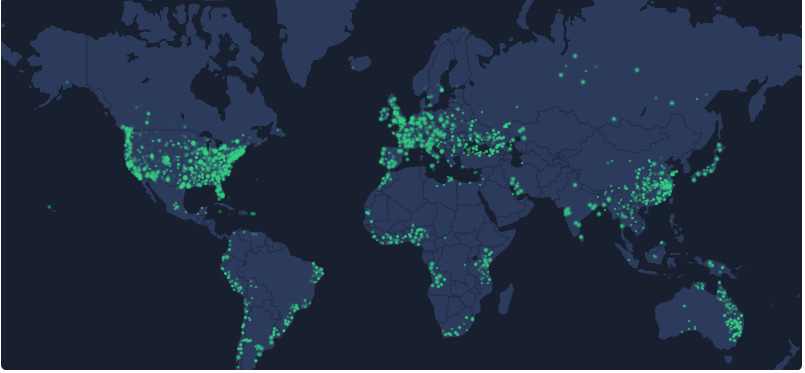
Image: The distribution of Helium Network worldwide(6).
The effective areas of coverage i.e., the green dots in the map showcases the density of the Helium network hotspots through the use of mappers, which are a variety of LoRaWAN GPS trackers, across the globe, highlighting its strong presence in the U.S., Europe and other cities around the world (6).
With coverage in over 77,000 towns and cities across 192 countries, including major metropolitan areas like Lisbon, Los Angeles, Sydney, Istanbul, and London, Helium has nearly one million hotspots deployed. It collaborates with over 25 hotspot manufacturers and has partnerships with major LoRaWAN roaming partners and a prominent carrier for 5G coverage. Helium primarily serves consumers, meeting their connectivity needs through a B2C (Business-to-Consumer) model. The launch of Helium Mobile's affordable unlimited plan has also driven the growth of new hotspots (5)
In the year 2024, Helium has achieved to promote smart city solutions like smart parking, environmental monitoring, and public safety applications, to improve urban management efficiency and resident’s quality of life. Helium has advanced its agricultural technology in farms and similar companies by providing solutions like sensor networks for real-time monitoring and management of crop environments, increasing agricultural productivity and yield and also collaborates with logistics and supply companies to implement logistics tracking solutions, enabling real-time monitoring of goods, thus improving logistics efficiency and transparency (7)
2.Long Fi (formerly Helium) by Nova Labs: focuses on IoT connectivity
It combines LoRaWAN with Wi-Fi HaLow blockchain for authentication and payments. Nova Labs developed Long Fi as a proprietary wireless protocol for their decentralized IoT network. While originating from Helium, Long Fi appears to be a more focused offering on IoT, possibly existing alongside or evolving from Helium's initial LoRaWAN focus.
Long Fi combines the super long-range powers of one technology (called LoRa) with the internet-connecting powers of Wi-Fi. This means your devices can be really far away from your house but you can still check on them from anywhere (8).
Image explains how Long Fi Technology works:
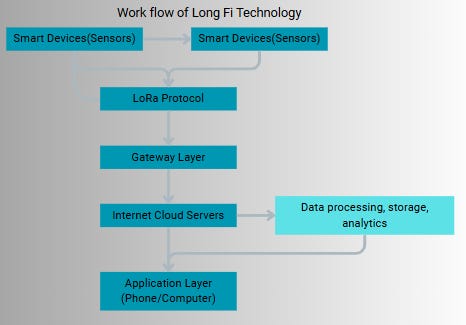
1.It collects information and sends it over really long distances - even miles away! They use very little battery power on the smart devices such as pet trackers, weather sensors and plant monitors.
2.The collected data is sent to the gateway layer which acts like a translator in converting the given information to be sent over the Internet.
3.Cloud Servers on the internet receive all this information, organize it, and store it safely.
4.This stored information can be displayed on your phone or computer (application layer) through an app.
Longfi is a global DeWi solution, mainly focused on frequency bands tailored for the US, EU, Asia, and Australia. The technology enables city-wide coverage with just 50-100 hotspots(9).
Anyone can participate by setting up a hotspot, earning cryptocurrency rewards, it also uses blockchain IDs for quick, secure device authentication. It enables IoT connectivity in smart cities, agriculture, and industrial applications.
As IoT devices proliferate, the demand for long-range, low-power connectivity is expected to grow significantly. Nova Labs is developing a 5G version using CBRS band along with an upcoming SDK release to encourage new applications (9).
Long Fi Technology Comparison with Other Wireless Standards.
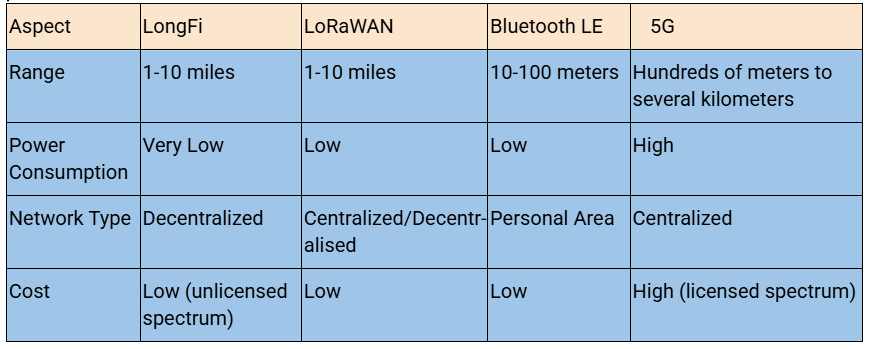
This comparative analysis shows Long Fi' s advantages over LoRaWAN, Bluetooth LE, and 5G across range, power consumption, network type, and cost. Long Fi combines long-range capability with very low power consumption in a decentralized network architecture that utilizes unlicensed spectrum for cost-effective coverage.
LongFi Technology is used by the farmers to keep tabs on their soil and crops health across huge fields, helping them water more efficiently and grow better harvests. Cities are getting smarter by connecting everything from street lights to trash bins, making urban life more efficient and eco-friendly. Factories are linking up machines throughout massive facilities to spot problems before they happen and keep production humming without constantly changing batteries. Perhaps most impressively, LongFi is helping environmental scientists track air and water quality in wild, remote places that were previously impossible to monitor consistently(8).
3.WiFi Dabba: Revolutionizing Internet Access in India
WiFi Dabba, founded in 2017, operates in the decentralized wireless (DeWi) sector, focusing specifically on consumer WiFi in India. The company has received backing from top-tier venture capital firms including Y-Combinator, Multicoin Capital, and Borderless Capital (10).
WiFi Dabba prioritizes addressing customer demand, focusing on users willing to pay for the service. The company empowers Local Cable Operators (LCOs) across India, partnering with over 150,000 LCOs nationwide. Dabba operates on a B2C (Business-to-Consumer) model with token incentives. The platform runs on the Solana blockchain, using smart contracts to distribute token incentives based on network contributions, with allocations adjustable through Dabba Improvement Proposals. The Dabba token has a maximum supply of 10B and has a fixed emission schedule and utilizes mint and burn model for its tokens.
As of March 2025, WiFi Dabba has deployed over 1,500 WiFi hotspots across India. The network serves more than 20,000 data consumers and in just six months, the network achieved over 1,000 TB of data consumption, connecting 25,000+ unique devices across Bangalore, Pune and kolhapur (11)
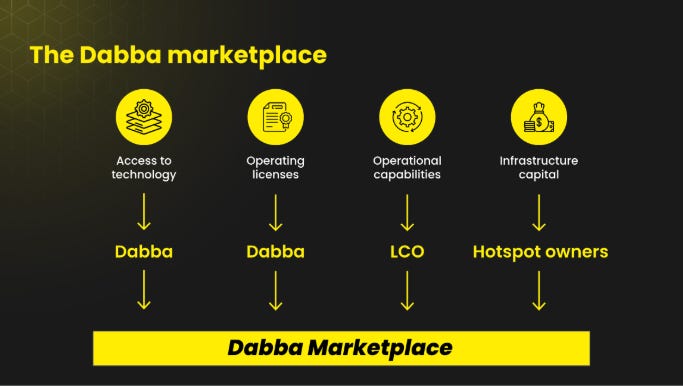
Image : Working of Dabba Network(10)
The Dabba marketplace facilitates interactions between hotspot owners, LCOs, and data consumers. Hotspot owners purchase and lease equipment to LCOs, who then compete for customers. Meanwhile, backhaul providers and hardware manufacturers complete the ecosystem by offering affordable connectivity and compatible equipment that meets the technical requirements of all participants, providing access to technology and operating licences.
The Dabba lite is an advanced indoor WiFi 6 router that provides public WiFi services while mining crypto tokens by running various applications, offering a space-efficient solution that reduces data access costs compared to conventional routers (10).
4. Roam: Building a Global Open Wireless Network.
Roam focuses on global WiFi infrastructure, bridging Web3 innovation like Decentralized Identifiers (DIDs) and Verifiable Credentials (VCs) with enterprise-grade telecom standards such as OpenRoaming™ and Passpoint™ ensuring seamless roaming between different WiFi networks (12). This positions Roam as a hybrid solution for public WiFi access and decentralized connectivity.
Roam operates on a B2C (Business to Consumer) model with token rewards, Roam enables users to earn tokens (Roam Points and $ROAM) for deploying hardware or validating connections. Participants expand the network by deploying Rainier MAX60 routers, which are enterprise-grade hardware, earning rewards for coverage and data validation (12).
While initially planning to integrate over 1 million WiFi hotspots globally, as of March 2025, Roam has exceeded expectations with over 3 million WiFi nodes and 2.5 million users, demonstrating significant growth in community engagement and network expansion (12).
Roam is exploring AI-driven data analytics to enhance network efficiency and user experience, while fostering a collaborative ecosystem by supporting other DePIN projects through its Discovery program.
The network ensures data privacy and security through DID/VC technologies, aligning with global regulatory standards.
5. XNET: Decentralized Mobile Networks.
XNET is building decentralized mobile networks leveraging Citizens Broadband Radio Service (CBRS) spectrum and WiFi 6+ technology on the Solana blockchain. Unlike traditional mobile carriers, XNET doesn't own extensive physical infrastructure but empowers community builders by providing access to its LTE/5G core and exclusive carrier WiFi offload agreements (13).
The company aims to disrupt the telecommunications industry by offering a decentralized alternative for mobile connectivity, focusing initially on the U.S. market while planning international expansion to high-traffic and underserved regions. XNET provides full-service carrier features including Voice, SMS, and E911 services (14).
XNET employs a B2B (Business to Business)/B2C (Business to Customer) model with token incentives. Their innovative heterogeneous network architecture combines multiple frequency bands (2.4, 3.5, and 5.0 GHz) and protocols (LTE, 5G, Wi-Fi 6/7), partnerships with major Mobile Network Operators like AT&T enhance scalability.
As of September 2024, $XNET has successfully migrated to the Solana blockchain. $XNET is an SPL-Token 2022 with a maximum supply of 2,400,000,000 (two billion, four hundred million) deflationary tokens ($XNET) (15).
The blockchain foundation creates incentives for network expansion through a token-based system, supporting seamless connectivity for over 150 million mobile devices. AI-driven resource optimization, enhanced security, and predictive maintenance capabilities deliver superior efficiency and user experience.
XNET faces ongoing challenges navigating complex regulatory frameworks around spectrum licensing and token classification, yet continues to position itself as an industry disruptor by addressing traditional barriers to entry and empowering community-led infrastructure deployment.
6. Andrena: Decentralized Internet Access Through Bandwidth Sharing.
Andrena is a decentralized wireless internet service provider that leverages the Solana blockchain to create an affordable and resilient internet infrastructure for residential and commercial buildings. Their DAWN (Decentralized Autonomous Wireless Network) protocol enables users to share bandwidth and earn rewards, was founded in 2017.
Users can participate in the network by installing Andrena's hardware and software, which enables them to securely share their unused bandwidth with others. As they contribute bandwidth, users earn Andrena's native token ($AND), which can be used for staking, governance, and access to additional services. This incentive model encourages widespread participation, creating a robust and decentralized network that can scale to meet growing demand for internet access (16).
Andrena Network’s Setup:
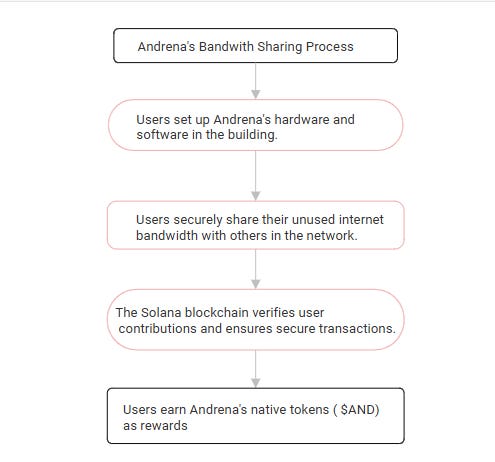
This flowchart explains how the incentive mechanism of Andrena's network functions (17).
As it positions itself as a disruptor to the traditional ISP model, Andrena has established connections in 10,000 households across 10 U.S. states. The company aims to cover over 3 million households at launch and expand globally, targeting underserved regions. This growth strategy aligns with projections for significant expansion in the global broadband market, driven by increasing demand for affordable internet access (17).
Decentralized Wireless (DeWi) Projects: Real-World Applications.
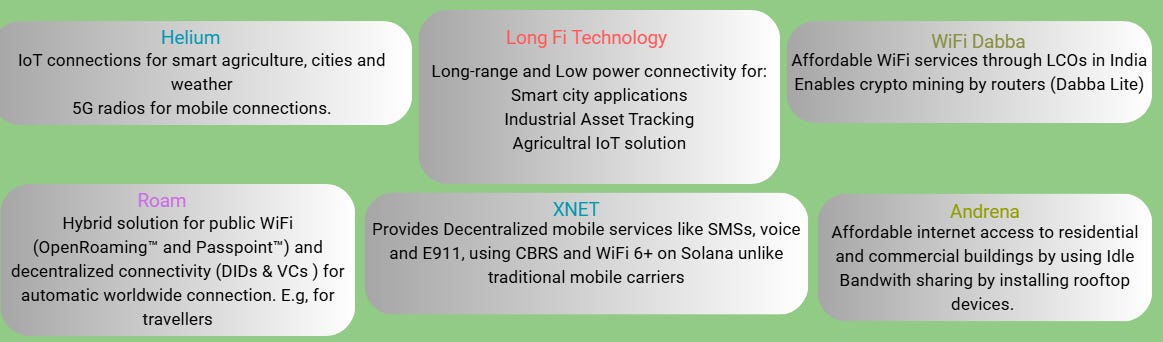
A Comparative Analysis of Decentralized Wireless Network Projects.
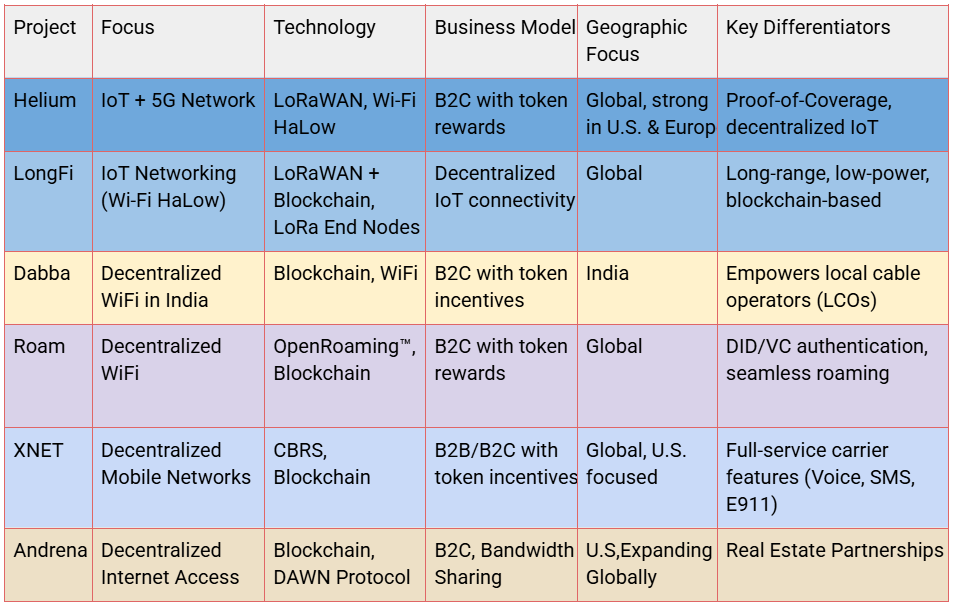
Community-Powered Connections for Tomorrow.
The Decentralized Wireless sector on Solana represents a vibrant and innovative frontier within the DePIN ecosystem These blockchain-powered networks aim to put connectivity back in the hands of everyday people. Projects like Helium, LongFi, Dabba, Roam, XNET, and Andrena are each carving out their unique niches by leveraging blockchain technology to build more open, accessible, and user-centric wireless networks. While challenges such as regulatory hurdles and technological development remain, the potential for DeWi to disrupt traditional telecommunications and internet service provision is significant. By understanding the distinct approaches, differentiators, and market positioning of these key players, we gain valuable insights into the future of connectivity and the transformative power of decentralized infrastructure.
References
1.Messari. (n.d.). The DePIN Sector Map. https://messari.io/report/the-depin-sector-map
2. PANews. (n.d.). An overview of the 2024 Solana DePIN ecosystem development status. https://www.aicoin.com/en/article/390527
3.Dune. “Helium Network Usage.” https://dune.com/helium-foundation/helium-data-credits.
4. Solana. (n.d.). Helium upgrades to Solana, establishes a new foundation for its future. https://solana.com/news/helium-upgrades-to-solana
5. Helium Foundation. (n.d.). A New Era for Helium Begins with Upgrade to Solana Blockchain.https://blog.helium.com/a-new-era-for-helium-begins-with-upgrade-to-solana-blockchain-88b742276ec1
6. iotoffgrid.com. (n.d.). Helium Coverage. https://iotoffgrid.com/docs/lorawan-coverage/helium-coverage/
7.gate.io. (n.d.). Introduction to the Helium IoT Network. https://www.gate.io/learn/articles/introduction-to-the-helium-iot-network/3529
8.Bit Harvest Studio. (n.d.). Long Fi Technology: Revolutionizing IoT Connectivity and Networks. https://bitharvest.studio/longfi-technology-revolutionizing-iot-connectivity-and-networks/
9.data-alliance. (n.d.). LongFi: Wireless Technology of Nova Labs (Helium Network). https://www.data-alliance.net/blog/longfi-wireless-technology-of-the-helium-network
10. Dabba Network. (n.d.). Dabba Network: Executive summary. https://gitbook.dabba.network/
11. Dabba Network. (n.d.). Map .https://explorer.dabba.network/map
12. DePin Hub. (n.d.). Roam – Building A Global Open Wireless Network. https://depinhub.io/blog/roam-building-a-global-open-wireless-network
13. XNET. (n.d.). XNET Docs. https://docs.xnet.company/overview/overview/
14. XNET. (n.d.). XNET DOCS.https://docs.xnet.company/build/deployments/
15. XNET. (n.d.). XNET DOCS. https://docs.xnet.company/token/overview/
16. Solana Compass. (n.d.). Solana Projects > Andrena.. https://solanacompass.com/projects/andrena
17. Light Reading. (n.d.). Equipped with $15M, Andrena aims to scale its wireless model.https://www.lightr
18.Claus Hetting, Wi-Fi NOW CEO & Chairman. “Wi-Fi percentage of US smartphone traffic at 74%, says Netradar.” https://wifinowglobal.com/news-and-blog/wi-fi-percentage-of-us-smartphone-traffic-at-74-says-netradar/.
19.CISCO. “Global - 2021 Forecast Highlights.” https://www.cisco.com/c/dam/m/en_us/solutions/service-provider/vni-forecast-highlights/pdf/Global_2021_Forecast_Highlights.pdf.
20.Wi-Fi Alliance®. “COVID-19 and the economic value of Wi-Fi®.” https://www.wi-fi.org/news-events/newsroom/new-study-covid-19-and-the-economic-value-of-wi-fi